
Criteria & Principles
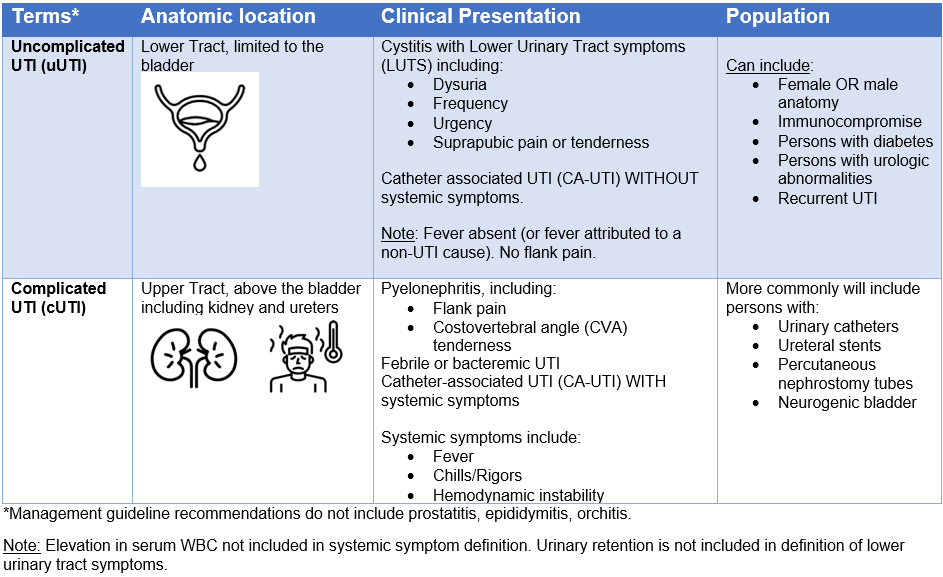
Refer to uncomplicated cystitis (uUTI) or asymptomatic bacteriuria pages for separate management guidance. Additionally, the UTI Evaluation page may be helpful guidance for challenging evaluations in patients with altered mental status, neurogenic bladder, and CA-UTI. There is additional information to answer your UTI diagnosis questions here.
Treatment
Duration
- Initial IV therapy (e.g. ceftriaxone) is recommended for hospitalized patients with concern for pyelonephritis, concurrent bloodstream infection, and/or hemodynamic instability. Prior urine cultures in the past 6-12 months may be helpful to guide empiric antimicrobial selection.
- The choice between agents should be individualized and based on microbiology data, patient allergy, renal function, medication adherence factors, or previous antibiotic use history.
| Patient condition | Agent | Dosing# | Duration of Therapy | Comments |
| Sepsis (without shock) or IV route of therapy only | Ceftriaxone | 1-2g IV every 24h | 7 days* | |
| Sepsis with septic shock | Piperacillin-tazobactam | 3.375g IV every 8h | 7 days* | |
| Sepsis with septic shock, known ESBL/drug resistant organism colonization in the last year | Meropenem | 500mg IV every 6h | 7 days* | |
| Without sepsis, oral route available | Ciprofloxacin | 500mg PO BID |
5-7 days* |
Patients should recieve at least 7 days of therapy if bacteremic UTI Caution, resistance rates at DUHS for E. coli are > 20% for TMP/SMX and fluoroquinolones. |
| TMP/SMX | 1 DS PO BID | 7 days* | ||
|
Amoxicillin-clavulanate (1st)
Cefuroxime (2nd) |
875/125mg PO every 8h
500mg PO every 12h |
7 days* |
Beta-lactams are preferred for step down from IV to oral therapy after appropriate clinical response. If ambulatory, consider 1 dose of IM ceftriaxone followed by 7 days course of oral beta-lactam. If considering other beta-lactams, see the respective customID pages. |
#Dose adjustments may be required for renal dysfunction
*Reassess for longer course (~10-14 days) if delayed response.
Severity
All Severity
References
1. Trautner BW, Cortes-Penfield NW, Gupta K, et al. Complicated Urinary Tract Infection (cUTI): Clinical Guidelines for Treatment and Management. Infectious Diseases Society of America. Published July 17, 2025. https://www.idsociety.org/practice-guideline/complicated-urinary-tract-infections/
2. Nicolle LE, Gupta K, Bradley SF, et al. Clinical Practice Guideline for the Management of Asymptomatic Bacteriuria: 2019 Update by the Infectious Diseases Society of America. Clin Infect Dis. 2019 May 2;68(10):e83-e110
3. Luu T, Albarillo FS. Asymptomatic Bacteriuria: Prevalence, Diagnosis, Management, and Current Antimicrobial Stewardship Implementations. Am J Med. 2022 Aug;135(8):e236-e244.
4. Cai T, Mazzoli S, Mondaini N, et al. The Role of Asymptomatic Bacteriuria in Young Women with Recurrent Urinary Tract Infections: To Treat or Not to Treat?” Clin Infect Dis. 2015 Sept 15;55(6):e771-777
5. Rotjanapan P, Dosa D, Thomas KS. Potentially inappropriate treatment of urinary tract infections in two Rhode Island nursing homes. Arch Intern Med. 2011;171(5):438-443.
6. Drekonja DM, Trautner B, Carla Amundson, MA, et al. Effect of 7 vs 14 Days of Antibiotic Therapy on Resolution of Symptoms Among Afebrile Men With Urinary Tract Infection: A Randomized Controlled Trial. JAMA 2021;326(4):324-331.
7. Yahav D, et al. Seven Versus 14 Days of Antibiotic Therapy for Uncomplicated Gram-negative Bacteremia: A Noninferiority Randomized Controlled Trial. Clin Infect Dis 2019;69(7):1091-1098.